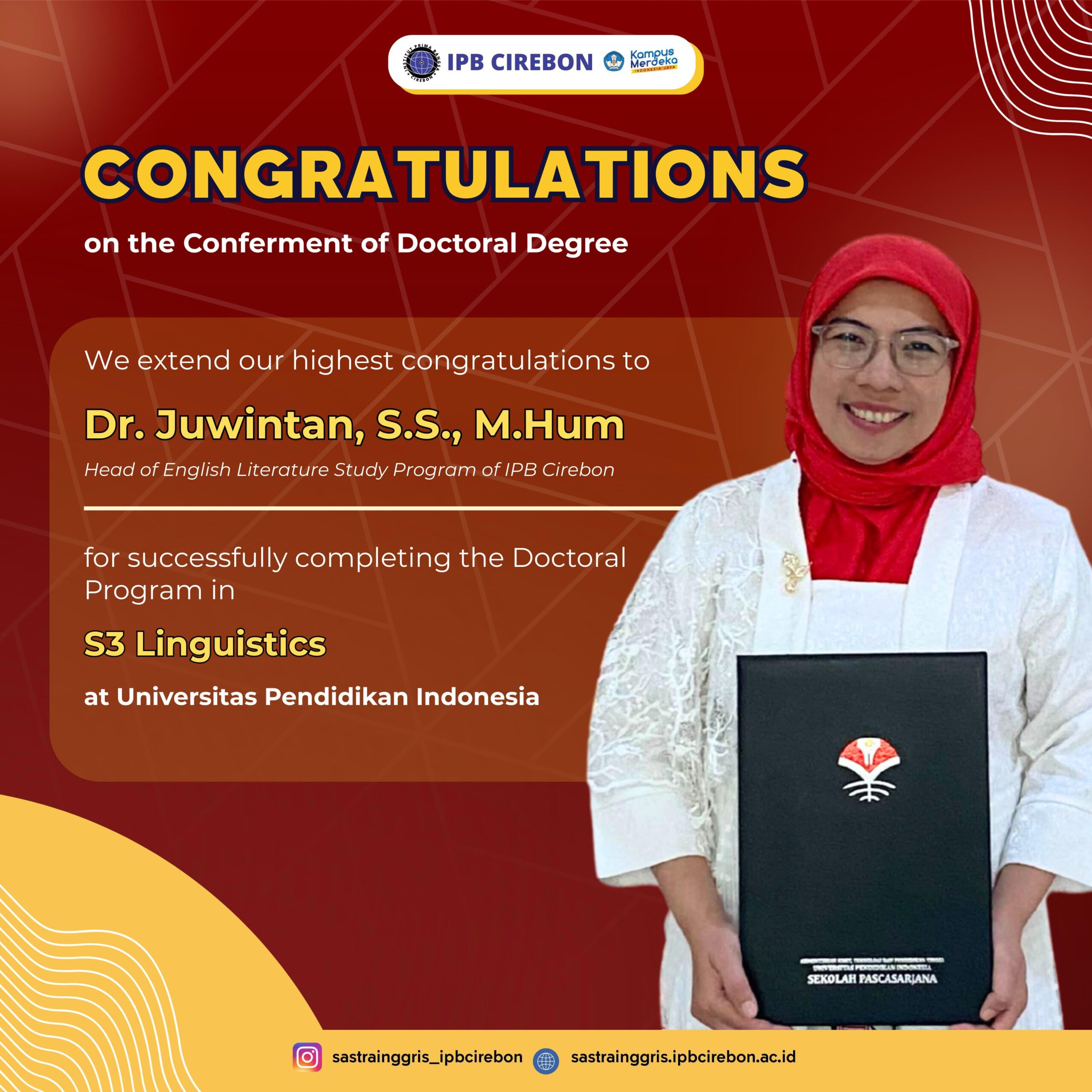
Cirebon – Language is identity, and preserving it is a way of safeguarding culture. Concerned with the decline of local dialects, Dr. Juwintan, Head of the English Literature Study Program at IPB Cirebon, conducted groundbreaking research to map the Javanese language in Cirebon. Her doctoral work at Universitas Pendidikan Indonesia (UPI) resulted in the creation of a Linguistic Atlas of Javanese Cirebon Dialects—a valuable resource to protect and revitalize local identity.
A Linguistic Atlas Through Geolinguistics and GIS
Dr. Juwintan’s research mapped variations of the Javanese Cirebon dialect across 267 villages in Cirebon Regency. Using geolinguistics combined with Geographic Information Systems (GIS), she documented 534 informants spanning multiple generations, gathering thousands of words and phonological variations.
The study covered coastal areas, inland regions, and eastern borders adjacent to Brebes, offering a comprehensive view of how Cirebon Javanese is evolving.
Key Findings: Phonological and Lexical Variations
The atlas highlights major phonological shifts, including vowel changes, consonant elision, and epenthesis (sound additions).
- Example: “mama” (father) is spoken as “mamo” in some areas.
- “bengi” (night) shifts into “wengi.”
Lexical differences are equally striking:
- “short” appears as cindek, cendek, endep, or pendek depending on the village.
- “to flow” is expressed as grenjeng, mili/milih, ngalir, or nglicir.
Mapping Zones of Language Change
Dr. Juwintan divided Cirebon into three language zones:
- Conservative Zone – Northern areas preserving older forms.
- Transitional Zone – Central areas blending old and new forms.
- Innovative Zone – Urban and eastern regions adopting new variations.
This zoning reveals that language change is ongoing, and without preservation efforts, original dialect forms may gradually disappear.
Cultural and Educational Significance
Beyond linguistics, the atlas serves as a cultural preservation tool. It provides educators, policymakers, and communities with a framework to safeguard endangered words and foster pride in local identity.
“If we don’t preserve it, our linguistic heritage will fade away. This atlas is not just about language—it’s about identity and culture,” Dr. Juwintan emphasized.
Conclusion
Dr. Juwintan’s research marks a milestone in documenting the living language of Cirebon. By transforming field data into a linguistic atlas, she has given future generations a map not just of words, but of identity.